









































Fly Kinetic
We’re going to start in the bargain bin and work our way up to the premium models. So – this is the Fly Kinetic. I have the Orange and Black Block Out graphic here, which retails just over 100 bucks.
And I’ve already told you the main thing I like – its price! Other than that, this just does everything that a motocross helmet is supposed to do at a decent level of quality.
I count 10 vents and 6 exhaust ports, which is respectable. I dug around the inside of this helmet too, and made sure that every single vent has a matching hole in the EPS liner. That’s really important, because a lot of manufacturers will trick you by putting mesh vents on the helmet shell and then not following it up with a hole in the foam underneath. Which is basically useless.
It’s nice to see that Fly didn’t pull that trick here, even on its cheapest model.
The Kinetic is DOT certified, so it’s not the safest helmet out there. But Fly has given us a dual-density EPS liner – lighter foam on top for little impacts, denser foam on the bottom for big mistakes. I suspect that the Kinetic is on the safer end of a DOT spectrum thanks to this system.
The last thing I love about this helmet is the weight. This large clocks in at 1458 grams, which is shockingly light for a plastic-shelled helmet. I found that this helmet fit true to the sizing chart online, and it’s a neutral head shape.
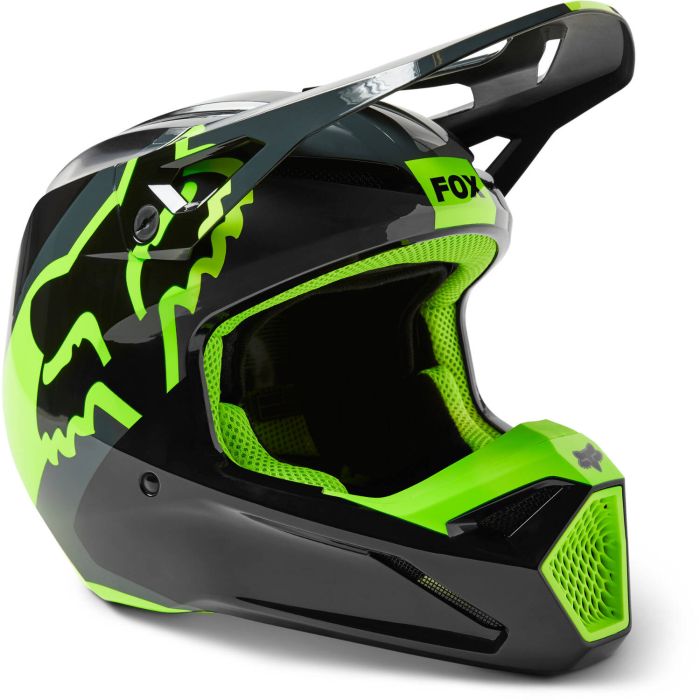
Fox V1 Race helmet
Now, for 190 dollars you can get the Fox V1 Race helmet. That’s a jump in 70 dollars from the Fly, which is hard to understand at first.
This large clocks in at 1505g, which is heavier than the Kinetic. It has 9 intake vents and 4 exhaust ports, which is one less than the Kinetic. And after wearing both helmets for a while, the padding in the V1 is definitely scratchier and less ventilated.
But, there are two big things that the V1 provides where the kinetic falls short. Firstly, this helmet has a DOT and ECE safety rating. Which makes it a much safer bucket for motocross or aggressive off-roading.
And the second thing: The V1 is way cooler looking. It comes in a million bright colourways – Honda Red, Kawasaki Green, KTM Orange – whatever. It’s also made to match other pieces of Fox gear, which is great if you want to put together a uniform kit.
I was obsessed with Fox Racing gear when I was a kid because they nailed moto style. And maybe I’m still obsessed, because I prefer this helmet to the Kinetic even though I know I shouldn’t.
The last thing I’ll say is to beware of sizing on this guy. My 58 centimeter head would put me squarely in a medium according to the chart online, but this neutral-head-shape Large fits me perfectly.
HJC’s RPHA-X
Now, we’re going to take a big leap forward with HJC’s RPHA-X. This is a 300-dollar helmet, which puts it in the middle price bracket. But believe me when I say this is top-end quality.
For the first time we’re seeing a premium shell construction come into play here. Like all of HJC’s RPHA line, this helmet uses their PIM System – Premium Integrated Matrix. Basically, it’s a weave of carbon fibre, Kevlar-like aramids, fibreglass and organic fibres (WB). That gives a maximum strength to weight ratio, which lets this helmet pass DOT and Snell certifications while remaining slim and light.
To put a number on it, this guy tips the scales at 1422 grams. Which is way lighter than anything else we’ve seen.
The ventilation on this helmet doesn’t look amazing at first – 11 intakes and 4 exhausts is nothing to write home about. But the RPHA-X is smarter than it looks.
Basically, HJC uses something they call the Advanced Channeling System – or ACS. The way this helmet is designed to cut through the air, it creates high pressure zones over the intake vents and low pressure zones over the exhaust ports. Meaning that it literally sucks cool air in and draws hot air out like an air conditioner.
The result is a double whammy. This is the most aerodynamic dirt helmet I’ve ever worn. And at the same time, it’s the second-best ventilated helmet I’ve ever worn.
The RPHA-X is really comfortable on the inside (wearing helmet). HJC uses gingko extract in the padding, which makes it almost silky while retaining the moisture-wicking, anti-bacterial and odor-free properties. Underneath the visor as well, there’s a tag for your racer info – name, birth date, phone number. And rather ominously – blood type (CU).
A lot of stuff gets jumbled in the pits. And these helmets might get really common once people discover how insane of a deal they are. So I think the info tag is actually useful.
My sizing on the RPHA-X matched the chart online. And it’s a neutral head shape that tends more towards the round side.
Klim F4
Now, earlier I mentioned that the RPHA was the second-best helmet I’ve ever worn in terms of ventilation. Well say hello to the number one – Klim’s F4. No joke – there are forty-one vents on this thing. Which pretty much blows away every helmet that has ever been made.
I’ve known Klim in the snowmobile world for a long time. But now they’re making a big push into the motocross market by making their F4 a multipurpose snowmobile and motocross lid. And let me tell you – the new kid on the block is also the king of the hill.
Forget Shoei VFX, forget the Bell Moto-9, forget Fox V4. Klim is doing everything better with the F4 and – while they’re still new to the dirt game – this helmet is wildly underpriced at 479 dollars.
You’re getting a fibreglass, carbon fiber and Kevlar shell, so it passes safety ratings while still being the slimmest of the bunch. And for how narrow the helmet is, it’s still a neutral head shape and the eye port is massive. Field of vision is unobstructed, and we’ve tried this lid with all kinds of goggles and haven’t had any fitment issues.
Now I never mention helmet bags in these videos. Some helmets come with nice ones, others come with shitty ones, but it just doesn’t matter because most people will never use it. With Klim though… I just had to show you this.
I mean what the hell!? Klim could charge 100 bucks for this duffel and get away with it. Go into the pockets, and you also find a free Gore-Tex wind-proof liner for the helmet and a breath guard … just in case you ride in colder weather or want to take this helmet snowmobiling.
Now I’m going to close with a serious warning. There is an ECE rated version of this helmet, and there’s also a DOT/Snell rated version. The ECE one is amazing – it’s lighter than the RPHA, it’s slimmer, it’s better in every way.
But the Snell version is a full pound heavier. So if you absolutely have to get a Snell helmet, forget the F4. Choose the HJC RPHA all day long.
And that’s it for my favorite dirt helmets! Thank you guys very much for watching.