













































Headsets vs. Neck Rolls
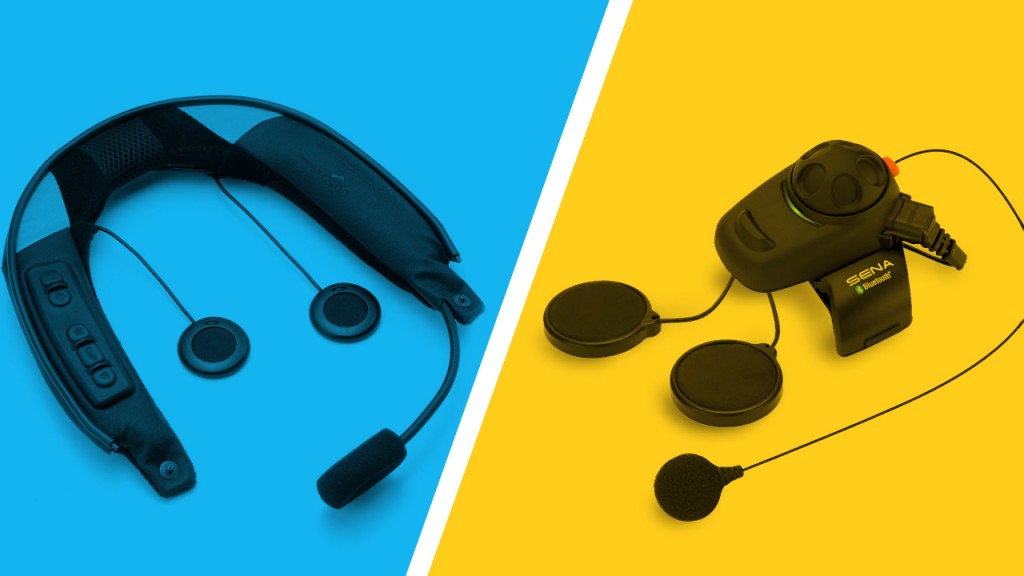
Communication systems are tough things to break down. So, let’s start by cutting our confusion-berry pie in half: headsets on one side, neck rolls on the other.
| Headsets | Neck Rolls |
|---|---|
| The body (electronics, button controls and sometimes the battery) is attached to the outside of the helmet. Installation involves sticking or clamping the body to the helmet. | The body (electronics, button controls and the battery) is built into the neck roll. Installation involves removing your helmet’s stock neck roll, and replacing it with the communication neck roll. |
| Normally waterproof or water resistant, although headsets encounter heavy environmental strain with the body mounted on the helmet’s exterior. | Normally water resistant. But since the neck roll is sheltered, it does not encounter much environmental strain. |
| Normally universal in fitment – they can be installed onto nearly any helmet.**Note: Most Nolans – and select Cardos and Senas – are exceptions to this rule. | Helmet specific in fitment. Each neck roll comm is designed to work with a specific helmet(s). Schuberth basically has a monopoly on this, although Cardo’s SHO-1 for SHOEI helmets is similar in design. |
| Headsets affect the helmet’s style, since they stick out the side a little bit. | Neck rolls don’t change the helmet’s stylish profile, since they simply replace the OEM neck roll. |
| Headsets affect the helmet’s aerodynamics, adding a bit of wind noise. | Neck rolls have no hindrance on aerodynamics, nor additional wind noise. |
| Installation is more complex than with neck rolls. | As helmet specific devices, neck rolls will have a seamless OEM fitment. This makes for simple installation. |
| Slightly more affordable. | Slightly more expensive. |
| By wires, the body is attached to thin speakers, which stick onto the inside of the helmet (one over each ear). | Just like a headset, the body is attached to thin speakers, which stick onto the inside of the helmet (one over each ear). |
| Normally, there is a microphone on a boom, which is positioned to sit in front of the rider’s mouth. | Just like a headset, there is normally a microphone on a boom, which is positioned to sit in front of the rider’s mouth. |
Headsets and neck rolls also differ in connectivity strength and range, but it’s not so black and white. Schuberth SRC systems for the C3 and C3W helmets have an antenna built into the neck roll, which makes the signal strength slightly weaker than on most headsets. On the flip side, SRC sysems for the C3 Pro and S2 connect to an antenna already built into the helmet. This makes their connectivity slightly stronger than with most headsets.
The bottom line: If you wear a Schuberth lid, one of their SRC neck roll comms will be the best choice. If you wear a SHOEI Qwest, XR-1100, Multitec, Neotec, J-Cruise, Hornet-DS or RJ-Platinum, check out Cardo’s SHO-1. In all other cases, a headset is the way to go.
